RPA to pioneer MA Programme in Peacebuilding and Post-conflict Resilience

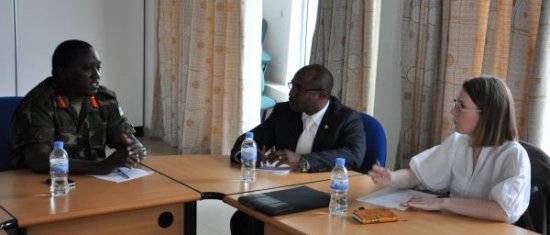
Maj. Gen. Karenzi Karake, RPA Director (left) discussing a point with Dr. Samuel Ewusi of UPEACE Africa Programme, Addis Ababa, and Prof. Victoria Fontan of UPEACE, Costa Rica, during a meeting at the RPA Liaison Office in Kigali
The Rwanda Peace Academy in collaboration with the University for Peace (UPEACE) is set to pioneer a new Masters of Arts Programme that may introduce a new paradigm in the region in peace and conflict studies.
The proposed MA Programme in Peace-building and Post-Conflict Resilience takes yet another step forward from the current trend in peace and conflict studies that emphasise conflict transformation and post-conflict recovery in the curriculum.
According to Prof. Victoria Fontan of UPEACE who is spearheading the design of the MA Programme, the current emphasis globally is on peacebuiling and is being spearheaded by the UN to focus on homegrown solutions which the RPA aims to tap into. Prof. Fontan is the Director of Academic Development and Head, Department of Peace and Security Studies, at UPEACE, Costa Rica.
The prevailing trend currently stresses on peacebuilding and post-conflict resilience, as opposed to post-conflict recovery as a paradigm that is more encompassing.
The proposed MA Programme in Peace-building and Post-Conflict Resilience at the Rwanda Peace Academy will follow the US-based system of academic credits, and will combine both face-to-face and e-learning components. The two first courses, Foundation Course in Peace and Conflict Studies, and Research Methods, will be taught face-to-face.
One of the innovative courses in the programme will dwell on “Intra, Inter-religious Dialogue and Faith-based Diplomacy”. The negative role of the Catholic Church in the Rwandan genocide is often analyzed, yet the role of intra and inter-religious dialogue in the establishment of sustainable peace in the region also has to be emphasized and conceptualized. This course will look into the intra, inter-religious and faith based initiatives that play an integrative role in today’s peaceful Rwanda. A new approach to understanding the scriptures will also be initiated.
Other proposed courses will include Foreign Policy, Peace-Building and Post-Conflict Resilience: a comparative analysis between Rwanda and Great Lakes States; Systemic Analysis of the Rwandan Genocide and Beyond; Words that Transform: the media and sustainable peace in post-Genocide Rwanda; Gender and Peace Operations in the Great Lakes; Practices of Conflict Management: Mediation, Negotiation and Transitional Justice in Rwanda; Sustainable Development and Social Entrepreneurship; Political Economy of the Great Lakes Region; and Capstone Workshop on Peace, Democracy Building and Community Development.
The “capstone” is to be established as a series of workshops and visits to key players in the post-Genocide Rwanda. It is designed to bring the academic, yet case studies based teaching of this program to the practitioners’ level of daily interactions with local communities and individuals. Key NGOs, group organizations, umudugudu communities, will be visited throughout this capstone workshop series.
According to Maj. Gen. Karenzi Karake, the RPA Director, “All courses will be of internationally recognized standards, but place a particular focus on both Rwanda and the wider Great Lakes region.”
He adds that stressing on resilience was the direction the RPA was taking not only with the MA programmes, but with the activities the RPA was engaged in, including hosting short courses.
Some of the short courses that have been hosted at the RPA include facilitating participation of future UN peacekeepers from Rwanda in March 2010 in a pilot testing of a training module on protection of civilians from sexual violence in post-conflict contexts. The module was developed by the United Nations Institute for Training and Research (UNITAR) Peacekeeping Programme.
In January 2011 the RPA in conjunction with UNITAR and the Kings College London conducted an international course on Understanding Conflict and Conf
The proposed MA Programme in Peace-building and Post-Conflict Resilience takes yet another step forward from the current trend in peace and conflict studies that emphasise conflict transformation and post-conflict recovery in the curriculum.
According to Prof. Victoria Fontan of UPEACE who is spearheading the design of the MA Programme, the current emphasis globally is on peacebuiling and is being spearheaded by the UN to focus on homegrown solutions which the RPA aims to tap into. Prof. Fontan is the Director of Academic Development and Head, Department of Peace and Security Studies, at UPEACE, Costa Rica.
The prevailing trend currently stresses on peacebuilding and post-conflict resilience, as opposed to post-conflict recovery as a paradigm that is more encompassing.
The proposed MA Programme in Peace-building and Post-Conflict Resilience at the Rwanda Peace Academy will follow the US-based system of academic credits, and will combine both face-to-face and e-learning components. The two first courses, Foundation Course in Peace and Conflict Studies, and Research Methods, will be taught face-to-face.
One of the innovative courses in the programme will dwell on “Intra, Inter-religious Dialogue and Faith-based Diplomacy”. The negative role of the Catholic Church in the Rwandan genocide is often analyzed, yet the role of intra and inter-religious dialogue in the establishment of sustainable peace in the region also has to be emphasized and conceptualized. This course will look into the intra, inter-religious and faith based initiatives that play an integrative role in today’s peaceful Rwanda. A new approach to understanding the scriptures will also be initiated.
Other proposed courses will include Foreign Policy, Peace-Building and Post-Conflict Resilience: a comparative analysis between Rwanda and Great Lakes States; Systemic Analysis of the Rwandan Genocide and Beyond; Words that Transform: the media and sustainable peace in post-Genocide Rwanda; Gender and Peace Operations in the Great Lakes; Practices of Conflict Management: Mediation, Negotiation and Transitional Justice in Rwanda; Sustainable Development and Social Entrepreneurship; Political Economy of the Great Lakes Region; and Capstone Workshop on Peace, Democracy Building and Community Development.
The “capstone” is to be established as a series of workshops and visits to key players in the post-Genocide Rwanda. It is designed to bring the academic, yet case studies based teaching of this program to the practitioners’ level of daily interactions with local communities and individuals. Key NGOs, group organizations, umudugudu communities, will be visited throughout this capstone workshop series.
According to Maj. Gen. Karenzi Karake, the RPA Director, “All courses will be of internationally recognized standards, but place a particular focus on both Rwanda and the wider Great Lakes region.”
He adds that stressing on resilience was the direction the RPA was taking not only with the MA programmes, but with the activities the RPA was engaged in, including hosting short courses.
Some of the short courses that have been hosted at the RPA include facilitating participation of future UN peacekeepers from Rwanda in March 2010 in a pilot testing of a training module on protection of civilians from sexual violence in post-conflict contexts. The module was developed by the United Nations Institute for Training and Research (UNITAR) Peacekeeping Programme.
In January 2011 the RPA in conjunction with UNITAR and the Kings College London conducted an international course on Understanding Conflict and Conf
Topics